
Plug-in solar panels could become one of the most accessible ways for UK households to generate a small amount of electricity at home.
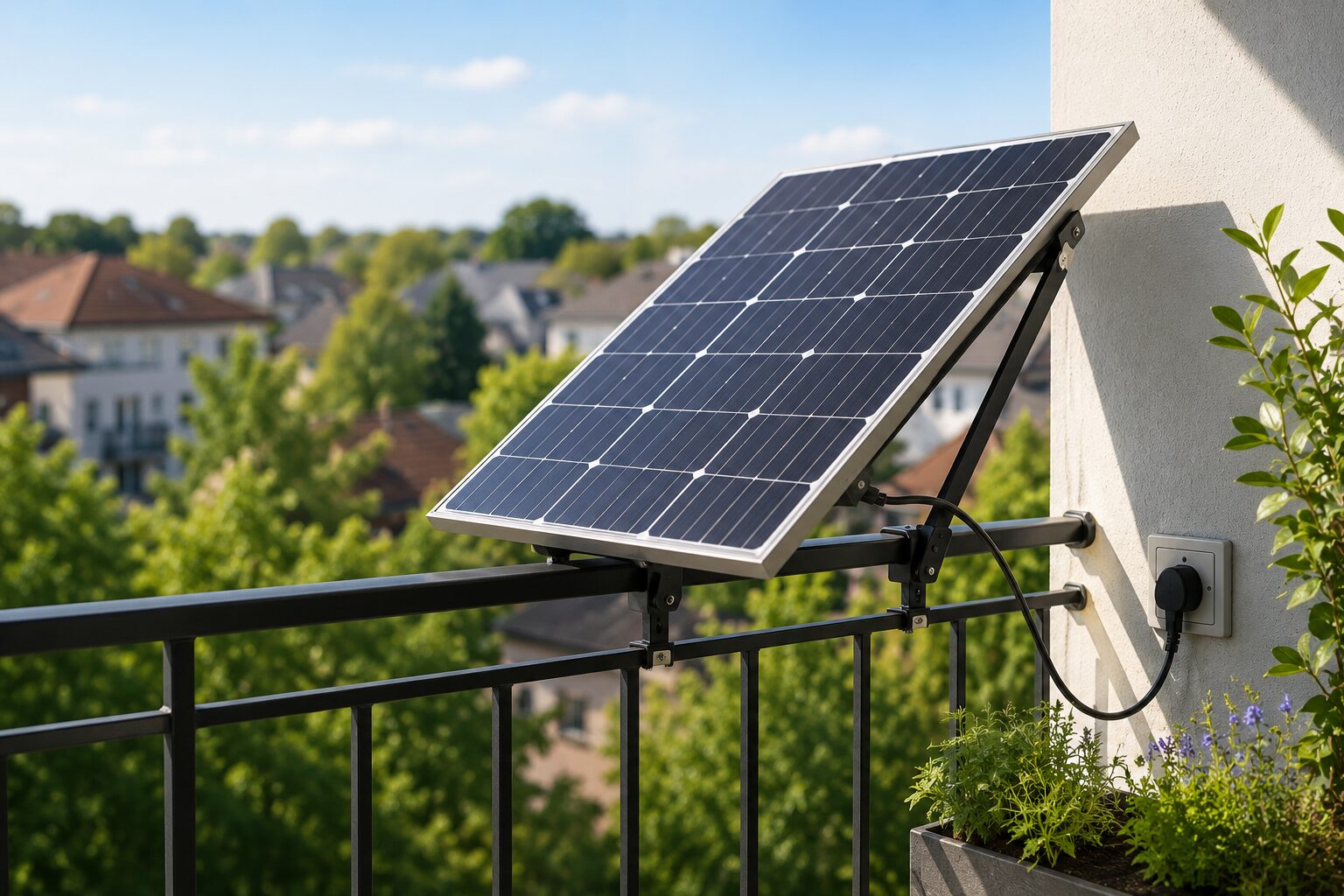
Unlike a full rooftop solar panel system, plug-in solar is designed to be smaller, cheaper and easier to install. Instead of fixing a large array to your roof, you use one or two solar panels on a balcony, patio, shed roof, garden frame, terrace or external wall.
The appeal is obvious. Renters, flat owners and people with unsuitable roofs have often been locked out of solar. Plug-in solar panels could change that by giving more households a lower-cost way to reduce the amount of electricity they buy from the grid.
But there is a catch: the UK market is still developing.
The government has announced plans to make plug-in solar panels available in shops, with major retailers and manufacturers working on a UK rollout. However, that does not mean every “plug-and-play” solar kit sold online today is approved, compliant or safe for UK homes.
Here’s what you need to know before buying.
What are plug-in solar panels?
Plug-in solar panels are small solar PV systems designed to connect to a home more simply than a standard rooftop solar installation.
They are also known as:
- Balcony solar panels
- Plug-and-play solar panels
- Mini solar panel systems
- Plug-in solar kits
- Balcony power stations
- Micro solar systems
A typical plug-in solar kit may include:
- One or two solar panels
- A microinverter
- Mounting brackets or a frame
- Cables
- A plug or connection unit
- App-based monitoring
- Sometimes a battery
The panels generate direct current electricity from daylight. A microinverter then converts that electricity into alternating current, which your home can use.
The idea is that when your appliances are running during the day, they use your solar electricity first. That means you buy less electricity from the grid.
Are plug-in solar panels the same as rooftop solar panels?
No. Plug-in solar panels and rooftop solar panels use similar solar PV technology, but they are not the same type of system.
| Feature | Plug-in solar panels | Rooftop solar panels |
|---|---|---|
| Typical size | 1 to 2 panels | 8 to 14 panels |
| Typical output | Around 400W to 800W | Often 3kW to 6kW+ |
| Installation | Designed to be simple | Professional installation |
| Best for | Flats, renters, balconies, small spaces | Homeowners with suitable roofs |
| Upfront cost | Hundreds of pounds | Thousands of pounds |
| Bill savings | Modest | Much higher |
| Portability | Often removable | Permanent fixture |
| Battery option | Sometimes | Common add-on |
| Export payments | Unclear/emerging for plug-in systems | Often possible through SEG |
Plug-in solar panels are not designed to power a whole home. They are designed to reduce your daytime grid use.
For example, they may help offset background electricity from a fridge, router, laptop, TV, washing machine, chargers or home office equipment.
A full rooftop solar system is still the better option if you own your home, have a suitable roof and want the highest long-term savings.
Are plug-in solar panels available in the UK?
Some solar products are already available in the UK, but proper UK-approved plug-in solar kits for direct household connection are still emerging.
This is where buyers need to be careful, because several different products are being described in similar ways.
1. Portable solar panels and solar generators
Portable solar panels are already widely available in the UK from brands such as EcoFlow, Jackery, Bluetti and Anker.
These usually charge a portable battery power station. You then plug devices into the battery.
They can be useful for:
- Camping
- Garden offices
- Emergency backup power
- Outdoor events
- Small off-grid uses
However, this is not the same as a mains-connected plug-in solar system that feeds electricity into your home wiring.
2. Balcony solar systems from European brands
Balcony solar systems are already common in parts of Europe, especially Germany.
Brands such as EcoFlow and Zendure already sell balcony-style solar systems in European markets, including products with batteries and app-based controls.
These products show where the UK market is heading. But UK buyers should not assume that a product sold in Europe is automatically approved for UK socket connection, UK wiring rules, UK insurance requirements or UK network rules.
Always check the exact UK product documentation before buying.
3. UK retail plug-in solar kits
This is the part of the market that is still developing.
The UK government has said plug-in solar panels should become available in shops, with major retailers and manufacturers involved in the rollout.
Retailers and brands linked to the UK rollout include Lidl, Iceland, EcoFlow, Amazon, Currys, B&Q, Asda, Screwfix and Wickes.
That is a strong sign that plug-in solar is moving towards the mainstream. But until clear UK-approved kits are widely available, buyers should treat vague online claims with scepticism.
If a listing says “plug and play” but does not clearly explain UK compliance, inverter certification, installation requirements and DNO notification, avoid it.
How do plug-in solar panels work?
Plug-in solar panels work in four main steps.
First, the solar panels capture daylight and generate DC electricity.
Second, a microinverter converts that DC electricity into AC electricity that can be used by household appliances.
Third, the electricity is fed into your home’s electrical circuit.
Fourth, appliances running at the time use that solar power before drawing electricity from the grid.
The key point is timing.
Plug-in solar panels save the most money when you use the electricity as it is being generated. If your panels are producing electricity at midday but nobody is home and you have no battery, your savings may be lower.
You may benefit more if you can shift some electricity use into daylight hours, such as:
- Running the washing machine during the day
- Charging laptops and phones during daylight hours
- Using a dishwasher on a sunny afternoon
- Running home office equipment while the panels are generating
- Charging a small battery during the day for evening use
Are plug-in solar panels legal in the UK?
Plug-in solar panels can become a legal, safe option in the UK, but only if the system is approved for UK use and connected correctly.
This is the part many articles underplay.
A plug-in solar kit is not just another household gadget. It is a power-generating device that connects to your property’s electrical system. That means safety standards, inverter certification, anti-islanding protection, network rules, wiring rules, export limits and product instructions all matter.
Before buying, check whether the system:
- Is approved for UK household use
- Meets relevant UK electrical safety standards
- Has a certified microinverter
- Includes anti-islanding protection
- Explains whether it can connect to a standard socket
- Explains whether an electrician is needed
- Explains whether DNO notification is required
- Provides UK warranty support
- Provides safe mounting instructions
- Is suitable for your property type
- Is accepted by your landlord, freeholder or building manager
Do not buy a cheap imported solar kit and plug it into a household socket unless you are certain it is approved for that use in the UK.
If the seller cannot answer basic compliance questions, do not buy it.
What is anti-islanding and why does it matter?
Anti-islanding is a safety feature that stops a solar system from continuing to feed electricity into the circuit when the grid goes down.
This matters because electricity should not be exported into a supposedly dead circuit during a power cut. That could create a safety risk for engineers working on the network.
A compliant plug-in solar system should include inverter protection that disconnects safely when required.
This is one of the reasons you should avoid uncertified products. The microinverter is not a minor component. It is central to whether the system is safe.
Do you need to tell your DNO?
You may need to notify your Distribution Network Operator, usually called your DNO.
A DNO is the company responsible for the local electricity network in your area. It is not necessarily the same as your energy supplier.
Small solar systems are usually handled under simplified microgeneration rules, but the exact process depends on the system, its output and the final UK plug-in solar framework.
A reputable product should explain the DNO process clearly. If it does not mention DNO notification at all, that is a warning sign.
Before buying, ask the supplier:
- Is DNO notification required?
- Who submits it?
- Is it handled automatically?
- Is it included in the purchase process?
- What happens if the DNO needs more information?
- What documentation will I receive?
This is especially important if you live in a flat, a shared building or a property with unusual wiring.
How much do plug-in solar panels cost?
Plug-in solar panels should cost much less than a full rooftop solar panel system.
A basic one or two-panel kit is expected to cost hundreds of pounds rather than thousands. Systems with batteries, smart monitoring, premium mounting equipment or higher-end inverters will cost more.
As a rough guide:
- Basic plug-in solar kit: around £400+
- Premium plug-in kit: potentially £800 to £1,500+
- Plug-in kit with battery: likely higher again
- Full rooftop solar system: usually several thousand pounds
The lower price is the main appeal. But lower cost also means lower output.
A one or two-panel system will not generate anything like a full rooftop array. That does not make it pointless, but it does mean expectations need to be realistic.
How much electricity can plug-in solar panels generate?
Output depends on:
- Panel wattage
- Orientation
- Angle
- Shading
- Season
- Weather
- Location
- Inverter size
- Whether the panels are vertical or tilted
- Whether you use the electricity immediately
- Whether the system includes a battery
A typical plug-in solar system may be around 400W to 800W.
That is enough to offset some daytime electricity use, but not enough to run an entire household. It may help cover background loads, but it will not run electric heating, an oven, a shower, a heat pump or an EV charger in any meaningful way.
The biggest mistake is comparing a plug-in panel kit with a full solar installation. They are different products for different households.
How much could plug-in solar panels save?
Savings are likely to be modest, but still useful for the right household.
Government-linked estimates suggest plug-in solar panels could save some households around £70 to £110 per year. Actual savings will vary significantly.
You are more likely to save money if:
- Your panels get plenty of direct sunlight
- They face south, east or west
- They are not heavily shaded
- You use electricity during the day
- You work from home
- You can shift appliance use into daylight hours
- Your system is sensibly priced
- You can store excess power in a small battery
- You stay in the property long enough to recover the cost
You are less likely to save much if:
- Your balcony is shaded
- Your outdoor space faces north
- You are out all day
- You use most electricity in the evening
- You buy an overpriced kit
- You need extra electrical work
- Your landlord or freeholder restricts installation
- You cannot mount the panels safely
For many households, plug-in solar is not about huge returns. It is about reducing background electricity use and giving renters or flat owners a way to participate in solar for the first time.
Are plug-in solar panels worth it?
Plug-in solar panels may be worth it if you have sunny outdoor space, use electricity during the day and can buy a compliant system at a sensible price.
They are probably not worth it if your space is shaded, you expect large bill savings, or the kit is expensive relative to its output.
A simple example:
If a plug-in solar kit costs £400 and saves £80 per year, the payback period is around five years.
If the same kit saves £40 per year, the payback period is around ten years.
If a premium battery-based kit costs £1,200 and saves £100 per year, the payback period is around twelve years.
That does not mean the battery option is always bad. It may improve self-consumption, backup power and convenience. But from a purely financial point of view, batteries can make small solar systems harder to justify.
The most sensible buyer is someone who has a sunny balcony or patio, daytime electricity use and no realistic option to install normal rooftop solar.
Who are plug-in solar panels best for?
Plug-in solar panels are best suited to households that cannot easily install a full rooftop solar system.
They may suit:
- Renters
- Flat owners
- Maisonettes
- Homes with no suitable roof
- Homes with shaded or awkward roofs
- People with sunny balconies
- Garden office users
- Small homes with low electricity use
- Households wanting a low-cost entry point into solar
- People who may move home and want a removable system
They are less suitable for:
- Homes with no sunny outdoor space
- North-facing shaded balconies
- High-use households expecting major savings
- People who already have a good roof for solar
- Buyers looking at cheap uncertified kits
- Anyone unable to get landlord or freeholder approval
If you own a house with a good south-facing roof, a standard solar panel system will usually be a better long-term investment.
Do renters need permission for plug-in solar panels?
Yes. Renters should get written permission from their landlord before installing plug-in solar equipment outside.
Even if the system is removable, you may still be attaching panels to a balcony, railing, wall, fence, terrace or garden structure. That could affect the building fabric, appearance, safety, insurance or tenancy agreement.
Ask your landlord before buying.
You should also check:
- Whether external fixtures are allowed
- Whether balcony railings can be used
- Whether the system affects buildings insurance
- Whether an electrician is required
- Whether the product can be removed without damage
- Who is responsible if the panels fall or cause damage
- Whether the installation must be removed when you move out
Get approval in writing. Do not rely on a verbal “yes”.
Do flat owners need freeholder or managing agent permission?
Usually, yes.
Flat owners often do not have full control over external walls, balconies, railings, roofs or the building façade. These may be controlled by the freeholder, managing agent, residents’ management company or lease terms.
Before installing plug-in solar panels, check:
- Your lease
- Freeholder rules
- Managing agent rules
- Building appearance restrictions
- Fire safety requirements
- Insurance conditions
- Balcony load limits
- Mounting rules
- Planning restrictions
- Whether the building has shared electrical infrastructure
This is one of the biggest practical barriers for balcony solar in the UK.
A removable, non-invasive system may be easier to approve, but do not assume permission is automatic.
Do plug-in solar panels need planning permission?
In many cases, small domestic solar installations may not need planning permission. But plug-in solar panels on flats, balconies, listed buildings, conservation areas or external façades can be more complicated.
Planning rules may matter if:
- You live in a listed building
- You live in a conservation area
- The panels change the external appearance of the building
- The panels project from a balcony or wall
- The property is a flat or maisonette
- The installation is visible from the street
- The mounting system is permanent
Check with your local planning authority if you are unsure.
For renters and flat owners, planning permission is only one issue. Landlord, freeholder, lease and insurance approval may still be needed even where planning permission is not.
Can plug-in solar panels work with a battery?
Yes, some plug-in solar systems can work with a battery.
A battery can store solar electricity generated during the day so you can use it later, usually in the evening.
This can increase the amount of solar electricity you actually use yourself. That matters because small solar systems save the most money when their electricity is consumed in the home rather than wasted or exported for little or no reward.
However, batteries add cost. On a small system, that can make the payback period longer.
A battery may be worth considering if:
- You are out during the day
- You use more electricity in the evening
- You want backup power for small devices
- You have time-of-use electricity tariffs
- You value convenience as well as payback
A battery may be less worthwhile if:
- You already use electricity during the day
- The battery is expensive
- The system output is small
- You only care about shortest financial payback
Can you export electricity from plug-in solar panels?
This is still a developing area.
Full rooftop solar systems can often export excess electricity through the Smart Export Guarantee, provided they meet the supplier’s requirements.
Plug-in solar is primarily designed for self-consumption: generating a small amount of electricity and using it immediately in the home.
Whether you can be paid for export from a plug-in system will depend on the final UK rules, your meter, the product, the supplier and whether the installation meets the relevant requirements.
Do not buy a plug-in solar kit assuming you will earn export payments unless the supplier confirms this clearly in writing.
What should you check before buying plug-in solar panels?
Before buying a plug-in solar system, check the following.
Product compliance
- Is it approved for UK homes?
- Is the microinverter certified?
- Does it include anti-islanding protection?
- Does it meet relevant UK electrical standards?
- Is it designed for a UK socket or UK connection method?
- Does it include clear installation instructions?
Installation
- Can it be safely mounted?
- Is the mounting system included?
- Does it need ballast, screws or clamps?
- Is it safe in high winds?
- Can it fall from a balcony?
- Can it be removed without damage?
Electrical requirements
- Does it need an electrician?
- Does it need a dedicated circuit?
- Can it connect to a standard socket?
- Is DNO notification required?
- Who handles the paperwork?
- Is your home wiring suitable?
Property permissions
- Do you need landlord approval?
- Do you need freeholder approval?
- Do you need managing agent approval?
- Does your lease allow it?
- Does your insurer allow it?
- Are there fire safety restrictions?
Financial return
- What is the total cost?
- Is mounting equipment included?
- Is a battery included?
- What is the expected annual generation?
- What is the realistic annual saving?
- How long will you stay in the property?
- What is the warranty period?
If the seller cannot answer these questions, wait.
Plug-in solar panels vs portable solar generators
Many UK shoppers will see portable solar panels and solar generators advertised alongside plug-in solar kits. They are not the same thing.
A portable solar generator usually means a battery power station charged by solar panels. You plug appliances into the battery.
A plug-in solar panel system feeds electricity into your home circuit, subject to UK rules and product approval.
Portable solar generators can be useful, but they are usually better for camping, backup power and off-grid use than reducing your whole-home electricity bill.
If your goal is to cut your electricity bill, make sure you understand which type of product you are buying.
Should you buy plug-in solar panels now?
For most UK households, the sensible answer is: wait for clearly approved UK products from reputable retailers or installers.
The market is moving quickly, and plug-in solar could soon become a practical option. But the risk right now is buying a product that is not properly approved for UK household connection.
You should be especially cautious with:
- Cheap imported kits
- Vague “plug and play” claims
- Listings with no UK certification details
- Products designed for EU sockets
- Systems with unclear inverter certification
- Sellers that do not mention DNO notification
- Products with no UK warranty support
- Balcony kits with weak mounting hardware
Plug-in solar is promising, but electricity generation is not something to bodge.
Final verdict: are plug-in solar panels a good idea?
Plug-in solar panels could be a useful option for UK households, especially renters, flat owners and people without suitable roofs.
They are cheaper, smaller and more flexible than rooftop solar panels. They could help reduce daytime electricity use and make solar more accessible to people who have previously been excluded from it.
But they are not a replacement for a full rooftop solar system.
Savings are likely to be modest, output is limited, and UK buyers need to be careful about safety, certification, DNO notification, landlord permission and freeholder approval.
If you own a home with a suitable roof, standard solar panels will usually be the better long-term investment.
If you rent, live in a flat or only have a balcony or patio, plug-in solar could soon become a practical way to generate a small amount of clean electricity at home.
The best advice for now is simple: wait for properly approved UK products, buy from a reputable supplier, and avoid cheap uncertified kits that do not clearly explain UK compliance.
FAQs
What are plug-in solar panels?
Plug-in solar panels are small solar PV systems designed to generate electricity from a balcony, patio, wall, shed roof or garden space. They use a microinverter to convert solar electricity into usable household electricity.
Can plug-in solar panels power a whole house?
No. Plug-in solar panels are much smaller than rooftop solar systems. They can help reduce daytime electricity use, but they will not power an entire home.
Are plug-in solar panels legal in the UK?
They are expected to become a legal mainstream option once UK rules, standards and product requirements are finalised. Buyers should only use systems clearly approved for UK homes.
Can I plug solar panels into a normal socket?
Only if the product is specifically approved for that use in the UK and the installation follows the manufacturer’s instructions and relevant rules. Do not plug in an uncertified imported kit.
Do I need an electrician?
Some future plug-in solar kits may be designed for DIY installation, but this depends on the product and final UK rules. If the supplier does not clearly explain whether an electrician is needed, do not buy it.
Do renters need landlord permission?
Yes. Renters should get written permission before installing solar panels on a balcony, wall, railing, terrace, shed or garden structure.
Do flat owners need freeholder permission?
Usually, yes. Balconies, external walls, façades and railings are often controlled by the freeholder, managing agent or lease terms.
How much do plug-in solar panels cost?
Basic kits are expected to start from hundreds of pounds, with more expensive systems including batteries, app controls and premium mounting equipment.
How much can plug-in solar panels save?
Savings vary, but estimates suggest some households could save around £70 to £110 per year. Actual savings depend on sunlight, shading, orientation, electricity use and system cost.
Are plug-in solar panels better than rooftop solar panels?
Not usually. Rooftop solar panels generate much more electricity and usually offer better long-term savings for homeowners with suitable roofs. Plug-in solar is mainly useful where rooftop solar is not practical.