
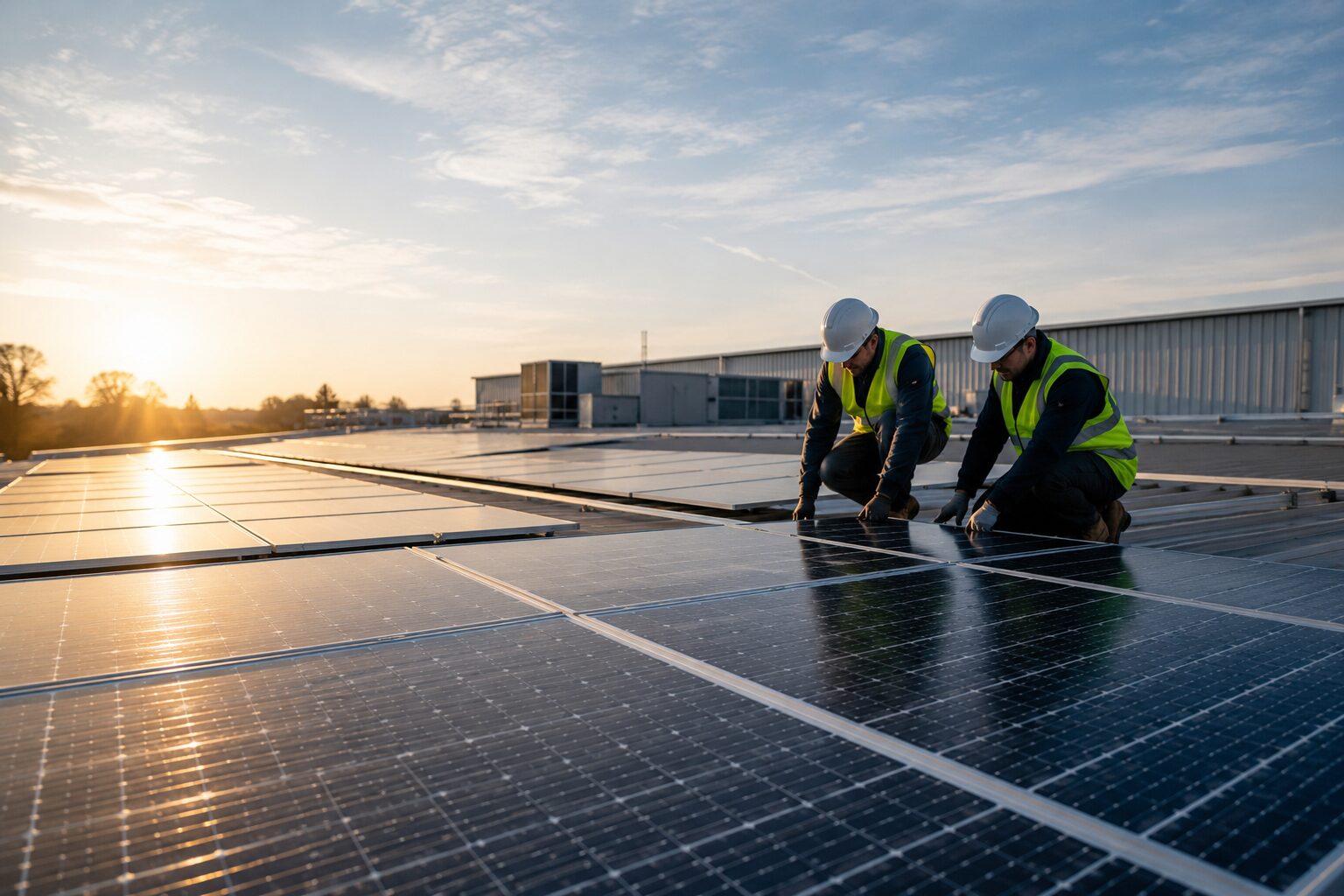

Electricity used to be one of those business costs you could budget for without thinking too hard about it. Not anymore.
For many UK businesses, energy has become a serious boardroom issue. Bills are higher than they used to be, prices can swing without much warning, and more customers, suppliers and investors are asking awkward but fair questions about carbon reduction. At the same time, thousands of commercial roofs across the UK are sitting there doing very little.
That is why more businesses are looking at commercial solar panels and battery storage. The idea is simple: generate more of your own electricity, use as much of it as possible on-site, store surplus power where it makes sense, and buy less from the grid.
Done properly, a solar and battery system can reduce operating costs, improve energy resilience and support long-term sustainability goals. Done badly, it can become an expensive roof decoration with disappointing returns.
That is where choosing the right solar and battery system installer for business matters. Commercial solar is not just domestic solar on a bigger roof. It involves proper design, usage analysis, structural checks, grid approvals, finance modelling, health and safety planning, and aftercare.
This guide explains what UK businesses need to know before investing in commercial solar PV and battery storage, including finance options, savings, the installation process and the key questions to ask before choosing an installer.
What Is a Solar and Battery System for Business?
A commercial solar and battery system usually combines two technologies: solar PV panels and battery storage.
Solar PV panels generate electricity from daylight. That electricity can be used by the business to power lighting, machinery, refrigeration, IT systems, heating, cooling, EV chargers and general operations.
Battery storage gives the business more flexibility. Instead of exporting unused solar electricity straight back to the grid, a battery can store some of that power for later. This can be useful during the evening, overnight, during peak tariff periods or when site demand rises.
Commercial solar and battery systems can be installed on many types of business premises, including:
- Warehouses
- Factories
- Farms
- Offices
- Schools and colleges
- Retail units
- Hospitality venues
- Care homes
- Leisure centres
- Logistics depots
- Cold storage facilities
- Industrial units
- Commercial carports
- Ground-mounted land
The best sites are usually those with good roof or land space and meaningful electricity usage.
A business that uses plenty of power during the day is often a strong candidate for solar because it can consume the electricity as it is generated. A business with evening or overnight demand may benefit more from adding battery storage.
The crucial point is that the system should fit the business, not the other way around.
Why UK Businesses Are Installing Solar Panels and Battery Storage
The main attraction is obvious: lower electricity bills. But that is not the only reason businesses are investing in solar.
[1] Lower Electricity Costs
When your business generates its own electricity, it buys less from the grid. For energy-intensive businesses, this can make a real difference.
The strongest savings often come when a business can use a large share of the solar electricity on-site. Exporting unused electricity may bring in some income, but the real value usually comes from avoiding expensive grid electricity in the first place.
This is why usage data matters. A good installer should not just look at your roof and quote a system. They should look at how your business actually uses energy.
[2] Less Exposure to Energy Price Volatility
Solar will not remove your business from the grid completely. That is not the point.
The point is to reduce how much electricity you need to buy and make part of your energy cost more predictable.
Once the system is installed, a portion of your electricity is being generated on your own site, rather than bought entirely from the market.
For businesses that hate nasty surprises in their overheads, that predictability has value.
[3] Better Use of Your Own Power
Without a battery, solar electricity has to be used immediately or exported. With a battery, you have more control.
A battery can store surplus solar power and discharge it later when the business needs it.
This can improve the economics of the system, especially if the site has evening usage, peak demand charges, time-of-use tariffs or EV charging requirements.
That said, battery storage is not automatically worth it for every business. It needs to be modelled properly.
[4] Lower Carbon Emissions
Commercial solar panels can help reduce the carbon footprint of day-to-day operations.
For businesses with ESG targets, tender requirements, supply chain pressure or public sustainability commitments, this can be important.
It also gives businesses something concrete to point to. Not a vague green pledge. An actual asset on the roof producing renewable electricity.
[5] Energy Resilience
Battery storage can also support energy resilience, but businesses need to be careful here.
Not every battery system provides backup power during a power cut. If backup capability is important, the system must be designed for it from the start.
That may mean extra equipment, specific wiring and decisions about which parts of the site need to stay running.
Do not assume “battery” automatically means “backup power”. Ask the installer directly.
[6] EV Charging
Many businesses are starting to think about electric vehicles, whether for staff, visitors, customers or fleets.
Solar and battery storage can be integrated with commercial EV charging to help reduce charging costs and manage demand.
This is particularly relevant for depots, logistics companies, farms, hotels, offices, retail parks and businesses planning to electrify vehicles over the next few years.
How Much Can a Business Save with Solar and Battery Storage?
This is where businesses need to be slightly sceptical.
There is no single savings figure that applies to every company. A warehouse, a farm, a school, a cold storage site and an office all use electricity differently. Their roofs are different. Their tariffs are different. Their operating hours are different.
Savings depend on factors such as:
- Current electricity prices
- Annual electricity usage
- Daytime demand
- Roof size and condition
- Roof orientation and pitch
- Shading
- Available land or carport space
- System size
- Battery capacity
- Export rates
- Operating hours
- Financing method
- Maintenance costs
- Grid connection limits
- Whether the business owns or leases the premises
A proper commercial solar quote should include a site-specific financial model. This should show estimated annual generation, expected on-site usage, exported electricity, annual bill savings, payback period, battery assumptions, maintenance costs, degradation and finance costs where relevant.
If a company gives you a payback figure without asking for your electricity data, be wary.
Businesses with high daytime electricity usage often see the strongest returns because they can use more of the solar power directly. Manufacturers, schools, offices, farms, warehouses, food producers and cold storage operators can all fall into this category.
Businesses that use most of their energy at night may still benefit, but the case for battery storage becomes more important. The installer should model whether the extra cost of the battery is justified by the additional savings.
The goal is not simply to install as many panels as possible. The goal is to install the right system for the way the business actually operates.
Financing Options for UK Businesses
There are several ways to pay for a commercial solar and battery system. The best route depends on cash flow, tax position, property ownership, appetite for debt and how long the business expects to remain at the site.
[1] Cash Purchase
A cash purchase means the business pays upfront and owns the system outright.
This usually gives the strongest long-term return because there are no finance repayments or third-party ownership costs. The business keeps the benefit of the electricity generated and any export income available.
The downside is obvious: it uses capital. That money may be needed elsewhere in the business. Before choosing this route, it is worth comparing the expected return from solar with other possible uses of the same funds.
Cash purchase is often attractive for profitable businesses with available capital, high electricity usage and long-term plans to stay at the site.
[2] Asset Finance or Hire Purchase
Asset finance allows the business to spread the cost over time. Depending on the agreement, ownership may transfer to the business after the final payment.
This can make solar more accessible because the business does not need to pay the full cost upfront. In some cases, the reduction in electricity bills may help offset the finance repayments.
However, finance costs matter. The monthly repayment, interest rate and total cost of borrowing should all be included in the financial model.
[3] Solar Lease
With a solar lease, a third party may own the system and lease it to the business. This can reduce upfront cost and may include maintenance.
The trade-off is that the business may not receive the same lifetime return as it would from owning the system. Lease terms also need careful review, especially if the business may sell the property, move premises or refinance.
If the building is rented, landlord permission is essential.
[4] Power Purchase Agreement, or PPA
A Power Purchase Agreement, usually called a PPA, is a common route for larger commercial solar projects.
Under a PPA, a third-party provider funds, owns and maintains the solar system. The business then buys the electricity generated by the system at an agreed rate, usually below the grid electricity rate.
This can work well for businesses that want lower energy costs without upfront capital expenditure.
But PPAs are long-term contracts. Businesses should review the electricity rate, price escalation clauses, contract length, maintenance responsibilities, roof access rights, ownership terms and what happens if the site is sold or vacated.
A PPA can be a smart option. It can also be a poor one if the terms are weak. Read the contract properly.
[5] Green Loans and Sustainability Finance
Some banks and lenders offer finance for renewable energy and energy efficiency projects. These may support solar panels, battery storage, EV chargers, LED lighting, heat pumps or wider decarbonisation work.
The details vary by lender, so businesses should compare interest rates, repayment periods, eligibility criteria and any security requirements.
[6] Grants, Tax Reliefs and Incentives
Funding support can change, so businesses should check the latest position before making decisions.
It is sensible to speak with the installer, accountant, finance provider and local authority about grants, capital allowances, VAT treatment and any local sustainability schemes.
The important thing is to base the investment case on current, confirmed support rather than old schemes or vague assumptions.
The Commercial Solar and Battery Installation Process
A good installation process should feel structured, not rushed. If an installer goes straight from a phone call to a quote without reviewing your site and electricity usage, that is not good enough.
Initial Consultation
The installer should start by understanding the business. What does the site do? When does it use electricity? Is the priority cost reduction, carbon reduction, EV charging, resilience or all of the above?
A factory running long shifts has different needs from an office. A farm has different needs from a retail park. The design should reflect that.
Energy Usage Review
This is one of the most important steps.
The installer should review recent electricity bills and, where possible, half-hourly meter data. This shows when the business uses energy and how much solar electricity it is likely to consume directly.
This stage is especially important when deciding whether battery storage is financially worthwhile.
Site Survey
The site survey should assess roof space, roof condition, orientation, pitch, shading, access, electrical infrastructure, structural suitability and possible battery locations.
Roof condition matters. Installing solar panels on a roof that needs major repair soon is a bad idea. Sort the roof first.
System Design
The installer should design the system around the building, usage profile and commercial objectives. This includes panel layout, inverter selection, battery size, cabling, monitoring, mounting systems and grid connection requirements.
Bigger is not always better. If a system generates large amounts of electricity that the business cannot use or export efficiently, the economics may suffer.
Financial Modelling
The financial model should be clear and realistic. It should include expected generation, self-consumption, exported electricity, annual savings, payback period, maintenance costs and any finance repayments.
Ask what assumptions have been used. Electricity price inflation, export rates, battery cycling, system degradation and maintenance costs can all change the result.
Planning Permission and Other Permissions
Many commercial rooftop solar installations may fall under permitted development, but this depends on the building, location, system size, listed status, conservation area rules and local planning requirements.
Businesses should also check landlord permission, lender consent, lease restrictions and insurance requirements. These can slow a project down if left until the last minute.
Grid Connection Approval
Commercial solar systems often need approval from the Distribution Network Operator, known as the DNO. This is particularly important for larger systems or systems that will export electricity.
The DNO may approve the system, limit export capacity, require additional equipment or request network upgrades. Any of these outcomes can affect the cost and payback.
A good installer should manage this process and explain the implications clearly.
Installation
Installation may involve scaffolding or access equipment, mounting systems, solar panels, inverters, batteries, cabling, electrical works and monitoring setup.
The installer should plan around business operations wherever possible. For some sites, work can be phased or scheduled to reduce disruption.
Testing, Commissioning and Handover
Once the system is installed, it should be tested and commissioned. The business should receive documentation, certificates, warranties, monitoring access and maintenance instructions.
The handover matters. Someone on-site should understand how to monitor the system, who to contact if there is a fault and what normal performance looks like.
Monitoring and Maintenance
Commercial solar systems are relatively low maintenance, but they are not “fit and forget”.
Monitoring helps detect faults, underperformance, inverter issues, battery problems or unexpected drops in generation.
Maintenance may include inspections, cleaning where needed, electrical testing, inverter checks, battery health checks and performance reports.
A system that is not monitored can quietly underperform for months before anyone notices.
Is Battery Storage Worth It for a Business?
Battery storage can be very useful, but it is not automatically the right answer.
A battery may make sense if the business:
- Generates surplus solar electricity during the day
- Uses electricity in the evening or overnight
- Has time-of-use tariffs
- Faces peak demand charges
- Wants to support EV charging
- Needs specific backup features
- Gets poor value for exported electricity
- Wants to use more of its own solar power
A battery may be less attractive if the business already uses nearly all the solar electricity as it is generated. For example, a manufacturing site with steady daytime demand may get strong returns from solar alone.
Battery sizing is where many projects go wrong. Too small, and the battery does not add enough value. Too large, and the system becomes more expensive than it needs to be.
The installer should use real consumption data to recommend battery capacity. Guesswork is not good enough.
Businesses should also ask about battery warranty terms, expected cycle life, location, fire safety, ventilation, temperature control, monitoring and replacement assumptions.
Important Considerations Before Choosing an Installer
The installer can make or break the project. A good one will challenge your assumptions, explain the numbers and design a system that suits your business. A poor one will sell you whatever is easiest to install.
Commercial Experience
Commercial solar is different from residential solar. Larger systems bring more complex electrical design, safety requirements, grid connection issues, structural checks and financial modelling.
Ask for examples of similar commercial projects. Not just nice photos. Ask what the system size was, what the business used it for and how the performance compared with the forecast.
Accreditation and Compliance
Check the installer’s qualifications, accreditations, insurance, health and safety processes and experience with UK commercial standards.
Cheap work can become expensive quickly if it leads to roof damage, poor performance, safety issues or warranty disputes.
Battery Expertise
Battery storage adds another layer of complexity. The installer should understand sizing, controls, warranties, fire safety, backup limitations, ventilation and monitoring.
If the battery is being treated as a casual add-on, that is a warning sign.
Realistic Savings Forecasts
The financial projections should be transparent. Watch for suspiciously short payback claims, vague assumptions or models that ignore maintenance and degradation.
A credible installer will be willing to explain the numbers, not hide behind them.
Roof Condition and Structural Suitability
The roof needs to be suitable for solar. That means checking condition, load capacity, access, drainage, fixing methods and expected lifespan.
If the roof is near the end of its life, deal with that first. Removing and reinstalling panels later will add cost.
Grid Constraints
DNO limits can affect system size and export capacity. This can change the business case.
Your installer should explain whether grid approval is needed, what the likely constraints are and how this could affect the project.
Fire Safety and Insurance
Speak to your insurer early. Some insurers have requirements around system design, battery location, fire access, isolation, maintenance and documentation.
Do not leave insurance questions until after the installation.
Warranties and Aftercare
Ask about warranties for panels, inverters, batteries, mounting systems, workmanship and monitoring platforms.
Also ask what happens if something goes wrong. Who responds? How quickly? Is performance monitored? Are annual inspections included?
Aftercare is not glamorous, but it matters.
Future Expansion
Your electricity needs may change. You may add EV chargers, expand production, electrify heating, add machinery or increase opening hours.
A sensible installer will consider future expansion during the design stage, rather than locking you into a system that cannot adapt.
Questions to Ask a Solar and Battery System Installer
Before choosing an installer, ask direct questions:
- How many commercial solar and battery projects have you completed?
- Have you worked with businesses like ours before?
- Can you review our half-hourly electricity data?
- What system size do you recommend and why?
- How much electricity will we use on-site?
- How much will be exported?
- Is battery storage genuinely worthwhile for this site?
- What payback period are you estimating?
- What assumptions are used in the financial model?
- Do we need DNO approval?
- Do we need planning permission?
- Does the roof need a structural assessment?
- How will installation affect business operations?
- What warranties are included?
- What monitoring and maintenance do you provide?
- What happens if the system underperforms?
- Can the system be expanded later?
The answers should be specific. If you get vague responses, push harder or look elsewhere.
Common Mistakes Businesses Should Avoid
The biggest mistakes usually happen before installation starts.
Common errors include:
- Choosing the cheapest quote without checking experience
- Installing the largest possible system without reviewing usage
- Ignoring battery sizing
- Failing to use half-hourly electricity data
- Forgetting roof repairs or structural checks
- Not speaking to the landlord, lender or insurer early
- Assuming batteries automatically provide backup power
- Overlooking DNO export limits
- Accepting unrealistic payback claims
- Failing to plan for monitoring and maintenance
Solar is a long-term business asset. Treat it like one.
How to Compare Commercial Solar Quotes
Do not compare quotes on headline price alone. A cheaper quote may exclude important costs or use weaker assumptions.
Compare:
- Solar system size in kWp
- Battery size in kWh
- Estimated annual generation
- Estimated self-consumption
- Export assumptions
- Equipment brands
- Inverter specification
- Monitoring system
- Warranty terms
- Installation method
- Scaffolding and access costs
- DNO application support
- Planning support
- Maintenance package
- Finance options
- Lifetime value
The best quote is not always the cheapest. The best quote is the one that gives the most credible long-term result.
Conclusion
For many UK businesses, commercial solar panels and battery storage can be a strong investment.
The right system can reduce electricity bills, improve control over energy costs, support carbon reduction and prepare the business for future needs such as EV charging.
But the details matter.
A system should be based on real electricity usage, proper site assessment and realistic financial modelling.
Battery storage should be included only where it makes commercial sense. Grid constraints, roof condition, planning rules, insurance requirements and maintenance should all be considered before installation begins.
Working with an experienced solar and battery system installer for business gives your company the best chance of getting a system that performs properly and pays back sensibly.
To find out whether commercial solar panels and battery storage are right for your site, speak to SolarAdvice.co.uk and compare installation options for your business.